
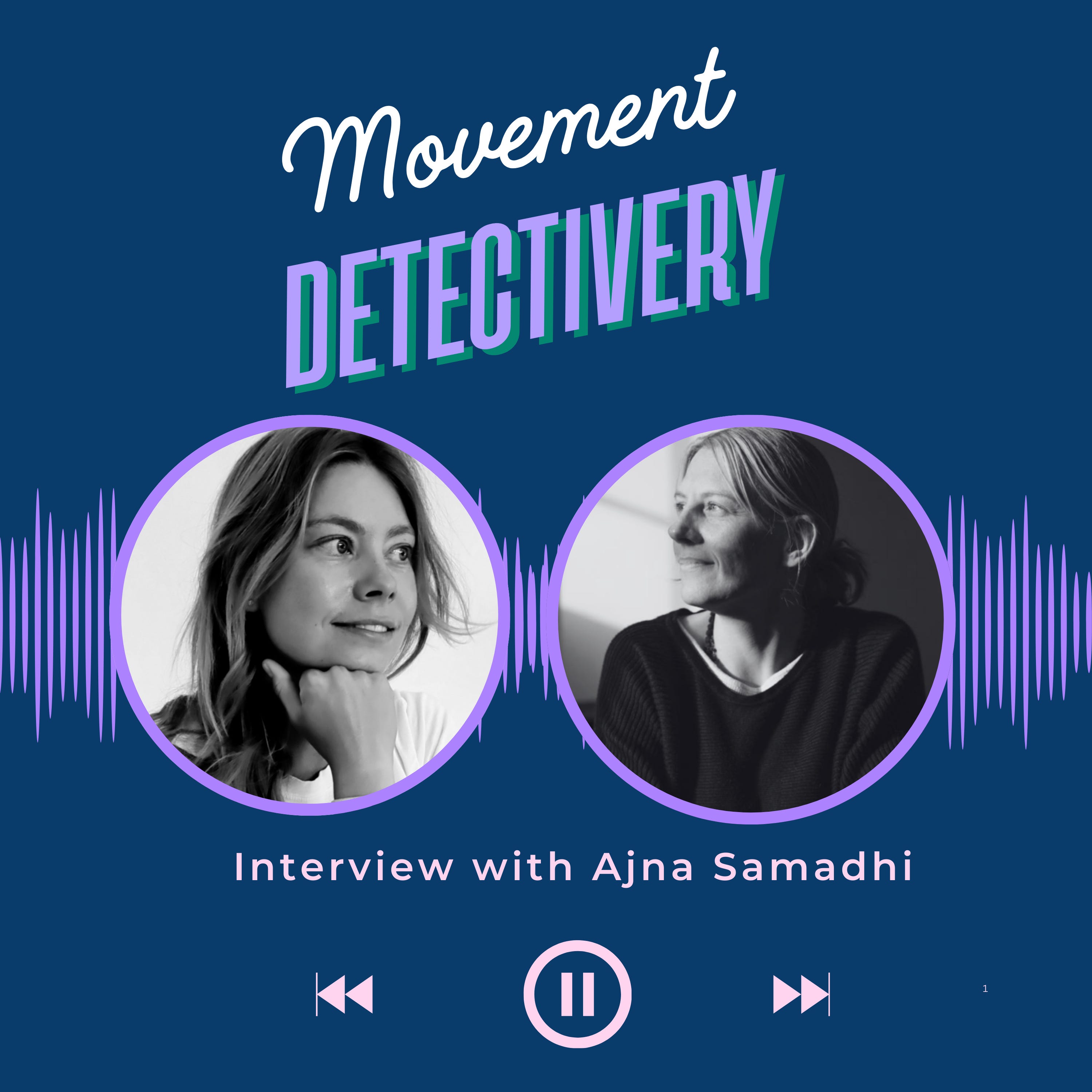
Ajna is a South-African born bodyworker who I originally bonded with due to our eerily similar life-paths: We both studied dance, moved to Toronto, danced professionally, got injured, stopped dancing and started studying Thai massage, realized there was more to helping bodies out of pain than working on muscles, and discovered the joy of studying anatomy, movement, and the mind-body connection as a way to help others.
We both studied Neurokinetic Therapy, Anatomy in Motion, and other continuing education courses together, and have collaborated on working with experimental bodywork “protocols” together that blend our love of exploring mind-body healing.
I wanted to speak with Ajna because of how well she is able to articulate her understanding of how our psyche affects our bodies. How unconscious beliefs, agreements, and behavioural patterns can be factors that cause and perpetuate our pain symptoms. Factors that aren’t always addressed in conventional manual and movement based approaches.
In my 20s I was very resistant to the notion that my emotional state- The ways I might be lying to myself, and my beliefs about myself and the world around me could have anything to do with my back pain. But in hindsight, though I credited my explorations of “healthy movement” as the primary thing that resolved my pain, I now see that it was through the journey of exploring movement and manual therapies that I indirectly began to encounter the ways in which my psychological conflicts were perpetuating my symptoms. 10 years later, I now see that, while movement helped reduce the mechanical strain on my body, the resolution of much of my body pain truly happened when I was able to move through these psychological conflicts and live in a state of less burden due to cognitive dissonance and unconscious emotional stress.
Ajna is dedicated to studying how the body, nervous system, and psyche impact on one another through her training in PDTR, manual therapy, and her work with the Dhyan Vimal Institute.
In 2022 when I was having foot problems I got immense benefit from enlisting Ajna as one of my trusted practitioners. She helped me to understand the unconscicous patterns and beliefs that were a component of what was keeping me in pain, and helped me to understand the changes I needed to make in my world to resolve it.
I think this interview will be beneficial for you if you are interested in somatic-based approaches to working with chronic pain that acknowledge that there is more going on than joint compression, muscle tension, and “bad” posture (though these are real considerations, too).
In our discussion, Ajna provides some background into the work she does and how it works. She also shares a lot of real life stories from her practice, and gives some practical tools you can use whether you are a practitioner or simply looking for tools to feel better in your own body.
In our conversation, Ajna and I discuss:
Do emotions always have a role in physical pain?
How pain is an “alarm system” alerting us to larger patterns in our lives that need attention.
How our symptoms may be manifestations of many broad, uninvestigated themes in our lives: Belief system, damaging values, lack of authenticity, and agreements we didn't know we made.
Ajna’s discovery of the Dhyan Vimal Institute for Higher Learning, and how implementing the knowledge she’s gained through her studies with him have informed her personal and professional practice.
The ABC meditation, which she feels to be one of the most effective, foundational ways to begin to build awareness of our reality an become less affected by external triggers.
How our bodies need truth for well-being, and how she uses muscle testing to understand whether someone’s body is working from a state of “honesty” or “corruption”.
And much more.
While I understand this conversation might fly under the woo woo banner for some folks, I strongly believe in what I’ve learned from Ajna and the information she shares connecting the psyche with our physical experience.
I hope you enjoy this interview with Ajna Samadhi and come away with some practical tools and insights for working with your body, and with others.
Where to find Ajna online:
Ajna’s Website: www.ajnasamadhi.com
Instagram: @ajna.samadhi
Dhyan Vimal Institute: DV Institute for Higher Learning
Here’s a little more about Ajna Samadhi:

Ajna started studying Thai Massage in 2008 and opened her practice in 2009.
She has studied many different modalities including NeuroKinetic Therapy (NKT) Anatomy in Motion (AiM), and Proprioceptive Deep Tendon Reflex (P-DTR).
She combines different techniques based on neuroscience, biomechanics, anatomy, and more subtle techniques to bring the body into a more balanced state. Her work helps restore the inherent integrity back into the system.
Her approach to the body is founded in the work of Dhyan Vimal, and her practice is constantly evolving as her learning continues.


